
Target Canada expansion failure: how a retail giant lost $2.1 billion in under two years

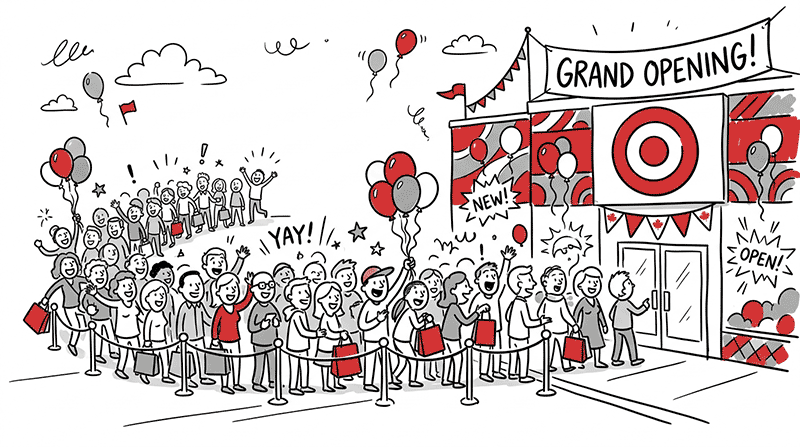
On March 5, 2013, Canadians lined up outside brand-new Target stores like it was Black Friday. They’d waited years for the red bullseye to cross the border.
Just 22 months later, every one of those stores was gone. Target had burned through billions and left roughly 17,000 Canadian employees without jobs.
Here’s the strange part: Target wasn’t some scrappy startup. It was one of the smartest retailers on Earth, so how did it get the basics so wrong?
Why Target looked unstoppable before Canada
To understand the fall, you have to understand how high Target was flying.
Target started in 1962 as a discount store in Minnesota. Over the decades it built something Walmart never could: a brand people actually liked. Shoppers jokingly called it “Tar-zhay,” a French-sounding nickname for a discount chain that felt a little fancy.
The secret was “cheap chic.” Target partnered with big-name designers, starting with architect Michael Graves in 1999, and put stylish stuff on affordable shelves. Customers walked in for toothpaste and walked out with a $40 lamp they didn’t plan on buying.
By 2012, Target was pulling in about $73 billion in annual revenue. Its U.S. growth was starting to cool, though, and Wall Street wants growth. So Target looked north.
The $1.8 billion shortcut: Zellers
Canada seemed like the perfect next step. It was next door, the culture was similar, and Canadians already loved Target. Many had been driving across the border to shop at U.S. stores for years.
In 2011, Target made its move. It paid about C$1.8 billion to take over the leases on a chunk of Zellers, a struggling Canadian discount chain owned by Hudson’s Bay Company.
That deal handed Target prime real estate in one shot. It was also the first domino, because those stores had to be converted and stocked fast.
This is where the Target international expansion strategy took a risky turn. Instead of starting small and learning, Target decided to open about 124 stores in a single year, 2013. That’s an enormous number for a company entering a new country for the first time.
The turning point: moving faster than the systems could handle
Normally, when a retailer expands, it tests the waters first. It opens a few stores, fixes problems, and scales up. Target skipped that step.
Think of it like opening 124 restaurants on day one without ever testing your kitchen. If the recipe doesn’t work, the mistake gets copied 124 times.
Behind the scenes, Target was building a brand-new supply chain from scratch. It had new warehouses, new software, and a new team that had never run Canadian logistics. The company also installed a new inventory system, and the system was only as good as the data fed into it.
And that data, by many accounts, was a mess.
The data disaster nobody saw coming
Every product in a modern retail system needs detailed info entered: size, weight, how many fit in a box, and what it costs. That information tells the computer how much to order and where to send it.
According to reporting in Canadian Business, much of the product data entered into Target Canada’s system was wrong or incomplete, with some accounts putting the error rate as high as 70%. Employees were reportedly under heavy pressure to hit deadlines, so mistakes slipped through.
The result was predictable. The system couldn’t tell what was actually in the warehouses, so it didn’t order the right things at the right times. Some products piled up in distribution centers while stores ran out of others.
Customers noticed almost immediately. Shoppers walked into shiny new Targets and found half-empty shelves. Social media filled up with photos of bare aisles.
Canadians had waited years for Target, and the first impression was a letdown.
Prices that sent shoppers back to the U.S.
Empty shelves were only half the problem. The other half was the price tag.
Canadians knew what Target charged in the United States. Many had shopped there on weekend trips, so they could compare prices instantly. When Target Canada priced many items higher than its American stores, the shoppers noticed, and it stung.
There were real reasons for higher costs, including import duties, bilingual packaging, and a more expensive supply chain. But customers don’t care about your logistics. They care about the number on the shelf.
Meanwhile, Walmart Canada was already well established with low prices and a huge footprint. Target had walked in claiming to be the cheaper, cooler option, and the receipts said otherwise.
The chain reaction
Once the cycle started, it fed on itself.
- Empty shelves meant fewer sales.
- Higher prices meant fewer repeat visits.
- Weak sales meant mounting losses, which put pressure on leadership.
Target kept investing, hoping it could fix the problems. It replaced the head of Target Canada in 2014, and the company had other troubles at home, including a massive data breach in late 2013 that led to its CEO’s departure in 2014.
In August 2014, Brian Cornell took over as CEO. He took a hard look at Canada’s numbers and saw no clear path to profitability.
On January 15, 2015, Target announced it was shutting down all 133 Canadian stores. Target Canada filed for creditor protection, and the stores closed in the spring of 2015.
Analysts tallied roughly $2.1 billion in operating losses from Target’s Canadian business between 2011 and late 2014, and that wasn’t the full bill. On the way out, Target booked a pretax impairment loss and other charges of about $5.1 billion tied to the exit. Other retailers swooped in to pick over the leftover real estate.
Key business takeaways (even if you don’t run a company)
You don’t need a corner office to learn from this one. Here’s what stands out.
1. Speed isn’t a strategy. Growing fast feels exciting, but scaling a broken process just breaks things faster. Target would’ve learned more from 10 stores than from 124.
2. Boring stuff makes or breaks you. Fancy branding is great, but the unglamorous work of tracking inventory and entering data correctly was a big part of what sank Target Canada. If the basics fail, nothing else matters.
3. Know the customer you’re actually serving. Canadians weren’t American shoppers living in a different place. They compared prices, remembered Target’s U.S. reputation, and expected the same value.
4. Your reputation travels, for better or worse. Target’s brand opened doors in Canada, but it also raised expectations. When a brand promises a lot and delivers less, the fall hurts more.
5. Knowing when to quit matters. It’s hard to walk away from billions of dollars, but Target’s new leadership cut its losses instead of throwing good money after bad.
The bottom line
The Target Canada story isn’t really about a retailer that was bad at retail. It’s about a company so confident in its own playbook that it forgot a playbook only works if the foundation is solid.
Target eventually bounced back at home, but Canada remains one of the most famous retail supply chain management failures ever. It’s now a business school classic for a simple reason: the mistakes were avoidable.
So here’s my question for you: were you one of the Canadians (or cross-border shoppers) who saw those empty Target shelves firsthand? And do you think Target could’ve pulled it off if it had gone slower? Drop your thoughts in the comments. I read every one.
Want more stories about why companies rise, fall, and make baffling decisions? Subscribe to the channel so you don’t miss the next teardown.
Meta description: Why did Target fail in Canada? Empty shelves, bad data, and sky-high prices turned a $1.8 billion bet into one of retail’s biggest flops.
© Nathan T, 2026. California, USA