BlackBerry downfall story: How a smartphone empire vanished

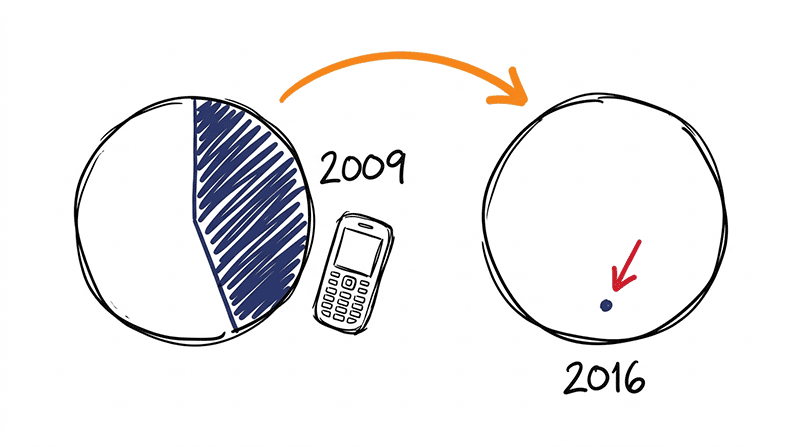
In early 2009, nearly half of all consumer smartphones sold in America had a BlackBerry logo on the back. Less than eight years later, phones running BlackBerry’s own operating system made up a share of global smartphone sales that rounded to zero.
It wasn’t a scandal or a fraud, and it wasn’t one bad quarter. So how does a gadget carried by CEOs, politicians, and even a U.S. president fall that far that fast? The answer starts with a treadmill.
The prime: when everyone had a “CrackBerry”
BlackBerry’s maker, Research In Motion (RIM), was founded in 1984 by Canadian engineering students Mike Lazaridis and Douglas Fregin. Jim Balsillie joined in 1992 and became co-CEO alongside Lazaridis.
Their secret weapon was secure, reliable, push email. A BlackBerry delivered messages instantly, the battery lasted, and the physical keyboard let you type fast with your thumbs. Corporate IT departments loved it because the BlackBerry Enterprise Server kept everything locked down.
The numbers show how dominant it got. In the first quarter of 2009, NPD Group found RIM accounted for nearly 50 percent of the U.S. consumer smartphone market. Verizon’s buy-one-get-one promotion helped, but the demand was real. A year later, comScore found 42.1% of U.S. smartphone owners had a BlackBerry, with the iPhone at 25.4% and Android at just 9.0%.
If you’d asked an analyst in 2009 who was winning the smartphone wars, the answer would have been BlackBerry. That makes what happened next even harder to believe.
The turning point: a treadmill, a webcast, and a shrug
In January 2007, Lazaridis was at home on his treadmill when he first saw the Apple iPhone on television. He took it seriously enough to pull Balsillie in front of a computer to watch the launch webcast. He pointed out that the iPhone carried a full web browser, something carriers wouldn’t allow RIM to put on its own devices.
Balsillie’s reaction was more relaxed. The two co-CEOs didn’t give the iPhone much additional thought for months.
Publicly, the tone was dismissive. Lazaridis and Balsillie belittled the iPhone’s short battery life, weaker security, and, in its early days, the lack of built-in Exchange push email for corporate users. Those criticisms weren’t wrong. They just missed the point.
The iPhone wasn’t trying to be a better BlackBerry. It was a pocket-sized computer that happened to make calls, and people wanted that more than they wanted a great keyboard.
The enterprise trap
Here’s the part that makes this a classic corporate adaptation failure. BlackBerry’s best customers were big companies, and big companies kept buying. Strong sales created a false sense of safety.
Meanwhile, employees started bringing iPhones to work and demanding that IT support them. BlackBerry had built its business around the buyer who signed the contract, not the person who used the phone every day. When those two groups split, the company was caught on the wrong side.
The downfall: a chain reaction
RIM did try to fight back. Verizon asked for a touchscreen “iPhone killer,” but the result was a flop, so Verizon turned to Motorola and Google instead. That phone was the BlackBerry Storm. Sales lagged the iPhone and customer returns were high.
The deeper problem was software. RIM’s aging operating system couldn’t handle 4G/LTE mobile broadband, so the company needed a total rebuild. That rebuild took years, and Apple and Google kept shipping.
Then came the part that stings most. The numbers kept climbing for a while even as the foundation cracked. BlackBerry’s handset sales actually peaked in 2011, at almost 52 million devices, according to Gartner. The company was selling record volumes of a product that was already losing the future.
The boardroom gets messy
Inside the company, leadership was fracturing. A Globe and Mail investigation based on interviews with about two dozen insiders described deep rifts at the executive and boardroom levels. In January 2012, with the share price below $16, Lazaridis and Balsillie were forced to step down as CEOs.
The new leadership bet everything on BlackBerry 10. It launched in early 2013, and market observers generally agreed the products were about two years too late. The first model out was the all-touchscreen Z10, even though Lazaridis had argued for leading with the keyboard phones. At the planning stage, he pointed to a keyboard BlackBerry and said he got it, then pointed to the touchscreen model and said he didn’t.
That comment sums up the whole story. The company’s founder understood the old BlackBerry perfectly and never fully embraced the new one.
The final numbers
The collapse was brutal. In the third quarter of 2008, RIM sold 5.8 million phones, which put it second worldwide, ahead of Apple’s 4.7 million. By the fourth quarter of 2016, Gartner counted only 207,900 smartphones running BlackBerry’s own operating system out of more than 432 million sold worldwide, a share of about 0.05 percent. BlackBerry-branded Android phones weren’t included in that count.
BlackBerry stopped making its own phones in 2016 and licensed its brand to TCL, which kept releasing Android-based devices until the deal ran out in 2020. And on January 4, 2022, BlackBerry shut down its legacy services for BlackBerry 7.1 and earlier and BlackBerry 10, leaving those devices unable to reliably handle data, calls, or texts.
The company itself survived by pivoting. It shifted to security software and services for corporate customers, but as a fraction of its former size.
Key business takeaways
So why did BlackBerry fail against the iPhone? Here’s what beginners can take from it.
1. Your best customers can blind you
Corporate buyers kept BlackBerry profitable, which hid the fact that everyday users were walking away. Always ask who your next customer is, not just your current one.
2. Strong sales can hide a dying strategy
Record handset sales in 2011 felt like proof things were fine. They were actually the peak before the cliff. Revenue tells you where you’ve been, not where you’re headed.
3. Don’t judge a new product by your old yardstick
BlackBerry picked apart the iPhone on battery life and security, the things it was best at. Apple was competing on something else entirely. If you only measure rivals on your strengths, you’ll always win the argument and lose the market.
4. Speed beats pride
Spotting the threat in January 2007 wasn’t the problem. Acting on it fast enough was. A late response to a platform shift isn’t a response, it’s a eulogy.
The bottom line
BlackBerry didn’t disappear because it was careless or stupid. It vanished because it was so good at one thing that it couldn’t see the world moving on. The same pattern shows up in corporate adaptation failures across every industry, from video rental to film cameras.
The most dangerous moment for a company isn’t when it’s struggling. It’s when it’s winning so hard that change feels optional.
What do you think was the real turning point: the 2007 shrug, the Storm flop, or the delay on BlackBerry 10? And did you ever own a BlackBerry? Tell us in the comments about your favorite model and what finally made you switch.
© Nathan T, 2026. California, USA